Logic In Medicine
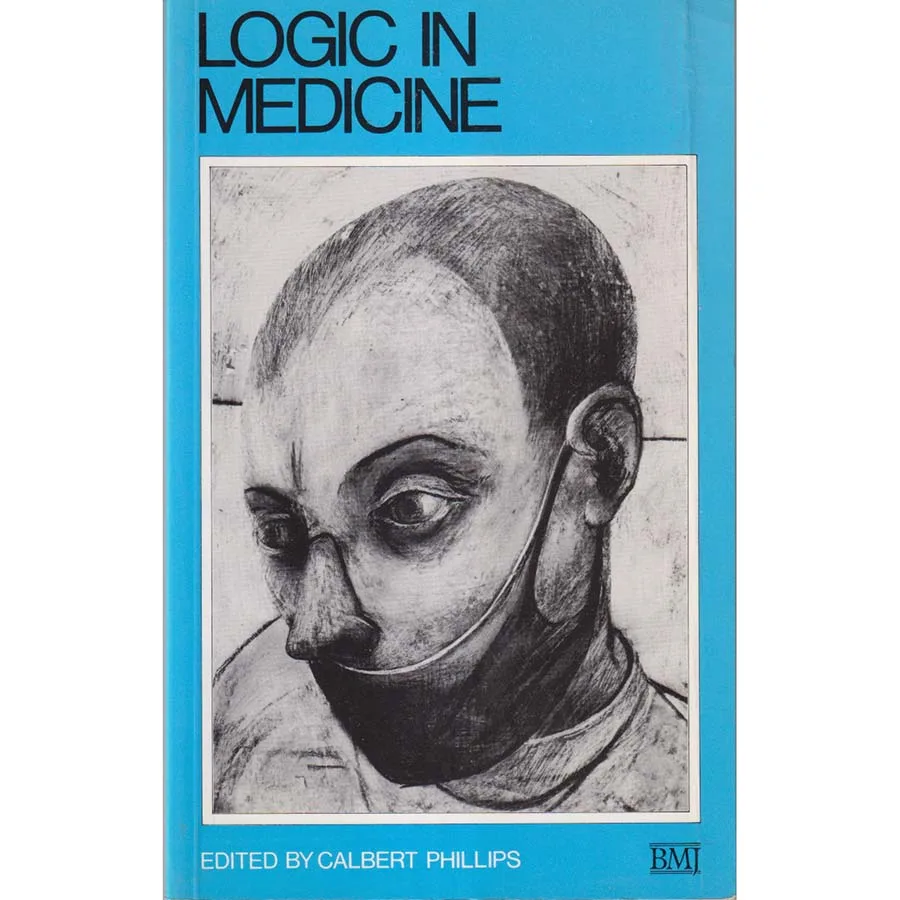
Publisher: British Medical Journal
Format: Paperback
ISBN: 0727902172
Medicine is a remarkable profession. A patient arrives complaining of a headache, the doctor asks a series of apparently unrelated questions, examines several parts of the body that seem to have nothing whatsoever to do with the head, and eventually announces a diagnosis with an air of reassuring certainty. Quite how this conclusion was reached is one of the great mysteries of modern life, although ideally it involves something rather more sophisticated than guesswork and a confident expression.
Logic in Medicine (1989), by Calbert Phillips and published by the British Medical Journal, examines the fascinating relationship between medical knowledge, logical reasoning and the complicated business of deciding what is actually wrong with somebody.
Medicine, despite its impressive collection of scientific instruments, laboratory tests and Latin terminology, remains fundamentally dependent upon human judgement. Doctors must interpret evidence, distinguish relevant symptoms from distracting coincidences, weigh competing explanations and reach conclusions despite the irritating tendency of patients to present themselves with problems that do not precisely match the textbook illustrations.
Logic, fortunately, provides a framework for navigating this intellectual obstacle course. It helps distinguish a reasonable conclusion from an attractive assumption, exposes weaknesses in arguments and encourages the medical profession to consider whether a diagnosis is supported by evidence or merely by the enthusiasm with which it has been delivered.
Of course, medicine presents particular difficulties for anyone hoping to apply perfectly tidy reasoning. Human bodies are notoriously uncooperative. Diseases share symptoms, apparently healthy people become ill, treatments produce unexpected results, and patients occasionally neglect to mention important details until halfway through the consultation.
The relationship between probability, evidence and certainty is therefore central to good medical thinking. A symptom may suggest one condition without proving it, a test may appear reassuring without excluding every possibility, and a fashionable medical theory may prove considerably less convincing once someone examines the assumptions beneath it.
Published in 1989, this volume offers an intriguing perspective on medical reasoning before the internet transformed every minor discomfort into a potential medical catastrophe. It belongs to an era when doctors were expected to develop their diagnostic judgement without patients arriving armed with seventeen competing theories downloaded from websites.
The subject remains remarkably relevant. Medical technology may have advanced enormously, but the underlying requirement to think clearly, question assumptions and distinguish evidence from speculation has not become any less important. Indeed, the more information available, the greater the temptation to mistake quantity for understanding.
Condition: Very Good. This 1989 British Medical Journal edition is a well-preserved, previously owned copy showing only modest signs of age and handling. A suitable addition to the shelves of medical professionals, students, historians of medicine and anyone interested in the intellectual machinery behind clinical decision-making.
Offered by Crappy Old Books, where we strongly believe in the importance of logical reasoning, although our own decision to establish a second-hand bookshop with a deliberately unflattering name might suggest otherwise.
An absorbing exploration of a subject that reminds us medicine is not simply about knowing things, but knowing how to think about them. And if there is one thing more worrying than a doctor who doesn’t know the answer, it is a doctor who has reached the wrong answer with impeccable confidence.
Keep browsing: See more Academic books Other books by Calbert Phillips